Header start
- Home
- News Index
-
News
News
Keio Holds 714th Mita Public Speaking Event: "Tokujiro Obata―Man of Wisdom, Man of Daring"
December 26, 2025
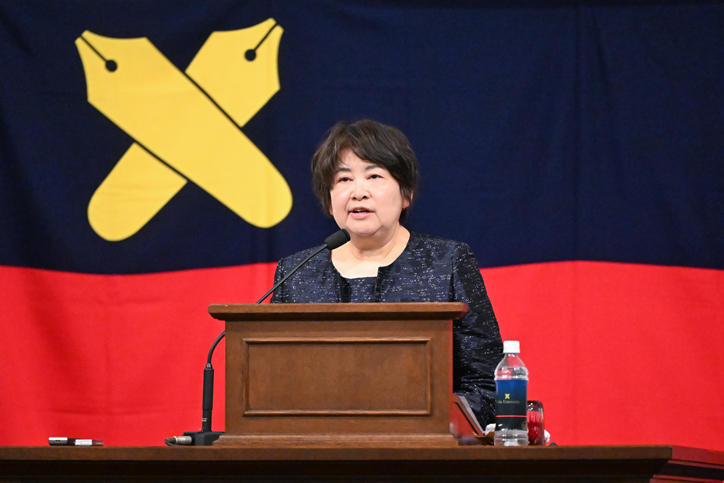
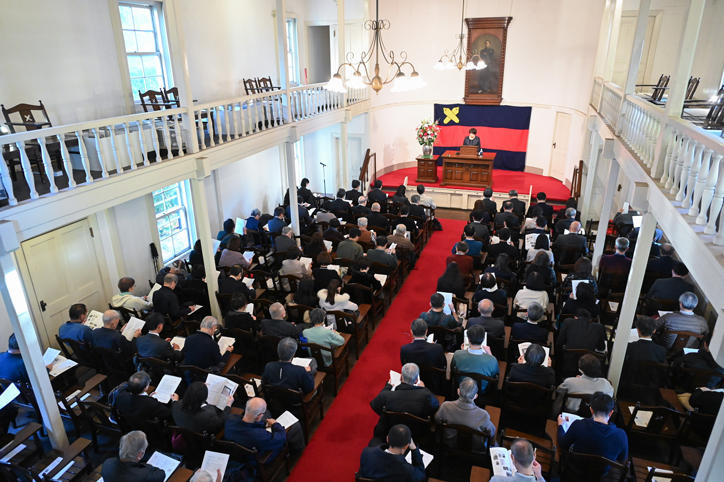
The 714th Mita Public Speaking Event was held at the Mita Public Speaking Hall (Mita Enzetsu-kan) on Tuesday, December 16. The Mita Public Speaking Event was first organized by Yukichi Fukuzawa and his pupils in 1874. Fukuzawa, who translated the English word "speech" into Japanese as enzetsu, introduced public speaking as an element of Keio University's curriculum. Since its inception, both Keio students and the general public have been welcome to attend. For its 714th iteration, the director of the Keio University Fukuzawa Memorial Institute for Modern Japanese Studies, Professor Naoko Nishizawa, took the podium to deliver a lecture titled "Tokujiro Obata―Man of Wisdom, Man of Daring."
In her lecture, Professor Nishizawa placed Fukuzawa's closest associate, Tokujiro Obata, in the spotlight, introducing his ideology and achievements. The story of Obata, who worked closely with Fukuzawa throughout his life, has often been overlooked. During the 2005 Yukichi Fukuzawa–Francis Wayland Memorial Lecture, which was held in commemoration of the 100th anniversary of Obata's death, Professor Nishizawa and the late Reijiro Hattori spoke of their project to publish a collection of Obata's works. 20 years later, Professor Nishizawa provided the audience with a behind-the-scenes look at the effort to bring the six-volume Collected Works of Tokujiro Obata to publication. She also touched on Obata's role as a key player in the original movement to establish the Mita Public Speaking Event. Professor Nishizawa explained that Obata's achievements went beyond those of a mere assistant to Fukuzawa, and highlighted the contributions he made as a scholar in his own right and their enduring influence.
Next, she spoke about Obata's origins, his meeting with Fukuzawa, and the extraordinary pace at which he mastered English studies. Professor Nishizawa pointed out that, throughout Obata's life, he remained devoted to the sharing of knowledge, and believed that neither class nor status should serve as an impediment to this goal. She also explained how Obata came to produce a substantial body of translated works during the early Meiji period. Using examples such as Tenpen Chii (The Extraordinary Workings of Heaven and Earth) and Seisan Michiannai (Introduction to Production), which included furigana (phonetic guide characters) and illustrations to make their content accessible to a general audience, Professor Nishizawa demonstrated how Obata placed emphasis on learning as a pursuit common to all members of society, rather than the exclusive domain of a privileged class.
A transcript of this lecture will be published in the February issue of the Mita-hyoron.