
Understanding the Chinese Psyche through the Novels of Lao She: Research Also Explores the Agony of "Pro-Japanese" Writers
Participant Profile
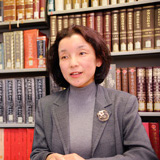
Motoko Sugino
Motoko Sugino
My specialty is modern Chinese literature, and my research has two main pillars. One is the study of Lao She. Lao She is a representative author of modern China, and his novel "Rickshaw Boy" and play "Teahouse" are highly acclaimed as the pinnacles of twentieth-century Chinese literature.
Lao She was from a poor Manchu family in Beijing and deeply loved the city and its people. His novels vividly depict the lives and feelings of the people of Beijing. His skillful use of the Beijing dialect is so renowned that it is featured in textbooks and used as example sentences in dictionaries. Furthermore, his experience in Britain triggered a growing sense of crisis about his country's future, which he projected into his works. His tendency to keep a distance from power and consistently maintain the perspective of the common people are aspects he shares with Japan's Natsume Soseki. I began reading novels as a way to get to know China, and I believe Lao She's works are essential texts for deeply understanding the Chinese people. He also felt both pride and a sense of burden as a Manchu during the transition from the fall of the Manchu-led Qing dynasty to the birth of the Han-led Republic of China. His uniqueness as a minority writer with these complex feelings is also part of his appeal.
The other pillar is research on Chinese writers who were active in Japanese-occupied areas like Beijing and Shanghai during the Second Sino-Japanese War. Among those who remained in the occupied territories, there were quite a few who, for a variety of reasons and under different circumstances, ended up collaborating with Japan. Many of these "pro-Japanese" writers were labeled as traitors and have long been buried in the darkness of history. I want to shed light on them once again.
I believe that as a Japanese person, it is my responsibility to meticulously explore the literary activities of each individual and the inner turmoil they experienced, torn between resistance and collaboration. A considerable number of Japanese-language newspapers and magazines from that period still exist in the former occupied territories, so I am currently continuing the work of locating these historical materials and examining them one by one to uncover the true stories of these writers.
How Do Novels and Films Portray the Light and Dark Sides of Modern China?
Modern China's economic development has been remarkable, and its GDP (Gross Domestic Product) is now on par with Japan's. However, social problems such as the gap between rich and poor and environmental issues are becoming more serious. I am very interested in how novels and films portray these light and dark sides of Chinese society. In the future, I would also like to work on translating and introducing contemporary novels.
*Affiliations, job titles, etc., are as of the time of the interview.