
Introducing German Theater to Japan via Performance Analysis and Sharing the Appeal of Japanese Theater with Europe
Participant Profile
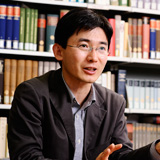
Eiichiro Hirata
Eiichiro Hirata
My work involves the analysis and research of performing arts, with a focus on German theater. This is centered on "performance analysis," which examines characteristics such as direction, acting, and stage design from various perspectives.
Unlike in Japan, theater in European countries was recognized as a form of performing art in civil society from the nineteenth to the twentieth century, and its significance beyond mere entertainment is widely understood. Since the 1980s, theater studies have gained importance in universities, and in addition to traditional historical and dramaturgical research, there have been active attempts to explore the characteristics of performances. German theater studies, in particular, are of a high standard and attract attention from theater researchers worldwide. Part of my job is to introduce this outstanding theater research to Japan.
To conduct performance analysis, it is necessary to watch plays live. I watch several dozen plays a year in Germany and introduce their characteristics and appeal to Japan. A key factor is the direction. The director brings together all the diverse elements, such as literary interpretation, visual and auditory direction, and the physicality of the actors. I hope that my performance analysis and theater research can serve as a reference for Japanese directors.
On the other hand, I am also involved in activities to introduce outstanding Japanese theater to Europe. Contemporary Japanese theater is largely an unknown territory to the rest of the world, and there were almost no books on the subject written in German, English, or French. Therefore, last year, I co-authored and published "Theater in Japan" with fellow researchers. It introduces Japanese theater in German, from the shingeki (new theater) of about one hundred years ago to the latest productions.
Theater Has the Power to Move Times and Society
Theater possesses an energy unique to the live, collaborative nature of its creation. This becomes a powerful force that can propel society forward. For example, Belgium's independence was achieved following a rebellion by an audience inspired by an opera performance.
Japanese society today, often described as lacking vitality, seems to be in search of a new kind of strength. This is evident from the large number of books sold with titles like "The Power of XX" or "How to Win with XX." However, brute force alone is no longer effective. What is needed in this global era is a complex strength that includes subtlety and can accommodate diversity. I want to introduce theater that can generate this kind of energy. I especially hope that young people, through the experience of theater, will acquire a vitality that is effective precisely because we live in difficult times.
*Affiliations, job titles, etc., are as of the time of the interview.