
Keio's Campuses Are a Treasure Trove of Archaeological Materials: Archaeological Research That Only Keio University Can Undertake
Participant Profile
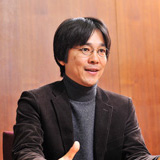
Hiromichi Ando
Hiromichi Ando
The three Keio University campuses—Mita, Yagami, and Hiyoshi—are all located on archaeological sites. The Hiyoshi campus, in particular, was nationally famous even before the war as a place where important ruins are spread throughout the entire area. However, when I was appointed to Keio in 2004, I realized that no one had a clear understanding of the preservation state of the ruins at Hiyoshi. Just as I began a survey of the current state of the ruins, Keio University's 150th anniversary was approaching. As various buildings were being constructed for the commemorative projects, it became clear that ruins still remained all over the campuses. In the last few years, we have conducted more than ten excavations, each yielding extremely important results.
We also investigated something unexpected. During the construction of the New Yochisha Gymnasium in Mamushidani, the entrance to a naval underground shelter built during the Asia-Pacific War was discovered. This is also an important archaeological site. Since there was no one else to take charge of it (laughs), I ended up leading the investigation.
It's natural to think that there would be many records of a facility built over 60 years ago. However, there were actually very few records, and this excavation revealed the special structure of the shelter's entrance for the first time. This was a real eye-opener. My specialty is the Yayoi period, so this was completely outside my field, but it unexpectedly made me realize the importance of archaeological methods in the study of modern and contemporary history.
Research That Only Keio Can Do, Research That Only I Can Do
My approach to research may be a little different from that of other university researchers. Normally, one would choose a research topic based on their own interests. In my case, rather than spontaneous interest, I first consider what Keio can do, what Keio should do, and what only Keio can do. Then, within that framework, I think about what I can do, what I should do, and what only I can do, and I tackle my research accordingly. This is related to the fact that I was a museum curator before coming here. I have been studying the Yayoi period since I was an undergraduate, but at the museum, I was required to conduct a wide range of research, not only on the Jomon and Kofun periods but sometimes even on the Silk Road. Of course, it's rewarding to achieve results even outside my specialty. I was truly happy when it was decided that the entrance to the underground shelter would be preserved.
Currently, in addition to my research on the ruins within the campuses, I am also working on organizing and analyzing the archaeological materials stored in the Archaeology and Ethnology laboratory, which were surveyed and collected by my predecessors from all over Japan. I believe this is also research that Keio should do and that only Keio can do, as well as research that I should do and that only I can do, and I intend to continue working hard on it.
*Affiliations, job titles, etc., are as of the time of the interview.