
Extending healthy life expectancy through self-care. Pharmacies are the ideal place for this kind of public education.
Participant Profile
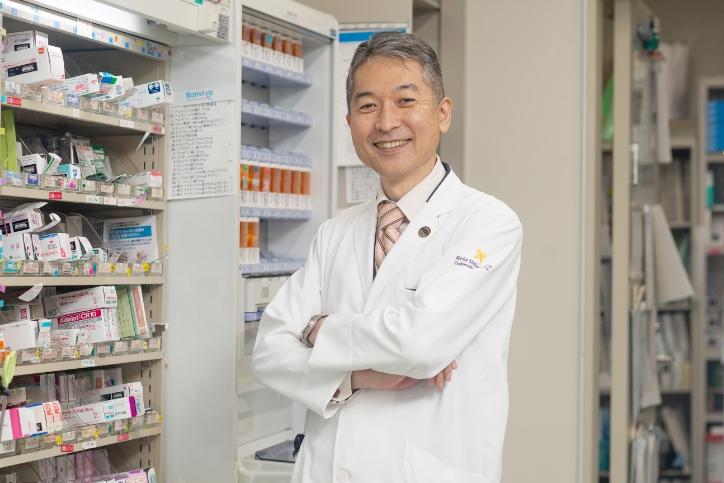
Katsunori Yamaura
Professor, Division of Social Pharmacy, Center for Social Pharmacy and Pharmaceutical Care SciencesKatsunori Yamaura
Professor, Division of Social Pharmacy, Center for Social Pharmacy and Pharmaceutical Care Sciences
Reducing ever-increasing medical expenses can be described as one of Japan's most critical issues today.
With both the national and local governments facing financial strain, self-care is gaining attention as a solution.
If individuals adopt habits such as striving for prevention and early detection, and using over-the-counter (OTC) drugs for minor ailments,
it will be possible to allocate medical expenses to those who truly need them.
In maintaining health or extending healthy life expectancy through such self-care,
pharmacies are the most suitable entities to lead public education.
The Keio University Faculty of Pharmacy has a University Community Pharmacy certified as a "Health Support Pharmacy,"
which serves the dual roles of promoting the health of local residents and providing practical education for pharmacy students.
(As of December 2023)
Social pharmacy is the field that aims to analyze and solve the various problems that hinder patients from continuing drug therapy by examining factors that influence medical systems and structures,as well as patients' perceptions, values, and behaviors regarding medicine and health.
We believe that whether pharmaceuticals provided to patients by healthcare professionals such as doctors, nurses, and pharmacists can exert their effects correctly depends on the social systems and structures surrounding the patients.
For example, since the COVID-19 pandemic began, there has been a persistent shortage of cough suppressants and fever reducers. Even if we want to prescribe them to patients, the drugs themselves are not in circulation. I believe this phenomenon has never occurred before. Additionally, the improper use of prescription drugs for weight loss, known as medical dieting, is rampant, causing supply shortages for patients who need the drugs for medical treatment. Another problem is the increasing number of young people who take large and frequent doses of OTC drugs (overdosing) to achieve a sense of euphoria similar to that from narcotics or stimulants. I think these problems are partly due to the increased accessibility of prescription and OTC drugs resulting from deregulation of their prescription and sale.
The academic field of social pharmacy studies these societal impacts on drugs and provides data or policy recommendations that can lead to a better healthcare system. There is a system called the self-medication tax system, which allows individuals who treat minor ailments like colds with OTC drugs to receive a special income tax deduction for the purchase cost. This is also a systemic solution to the challenge of how to ensure medical expenses are used for patients who truly need them.
My current research focuses on "self-care" and "oral care."The key to both is the existence of "Health Support Pharmacies."
I am currently focusing on two main research areas, one of which is self-care. The average life expectancy in Japan is 81.41 years for men and 87.45 years for women, but their healthy life expectancy is 72.68 years for men and 75.38 years for women, revealing gaps of about 9 and 12 years, respectively (*). To extend healthy life expectancy, self-care, where each citizen strives for disease prevention and early detection, is effective, and pharmacies are the most suitable for leading this public education. Generally, while many healthcare facilities are visited only after an illness or injury occurs, pharmacies are places where even healthy people can casually stop by, for instance, to buy household medicines or supplements.
Among pharmacies, there are special ones called "Health Support Pharmacies" that meet certain requirements set by the Ministry of Health, Labour and Welfare. They have pharmacists who have completed prescribed training and can offer a wide range of consultations, not only about medicine but also about diet and nursing care. There are about 60,000 pharmacies nationwide, but only about 3,000 are currently designated as "Health Support Pharmacies." The Keio University Faculty of Pharmacy's University Community Pharmacy is one of these few. In the coming era of self-care, the role of our University Community Pharmacy is significant.
The other research area I am focusing on is oral care. Periodontal disease is listed in the Guinness Book of World Records as "the world's most common disease," and it is said that about 70% of adults suffer from it. Evidence is accumulating that this periodontal disease is an exacerbating factor for systemic diseases, affecting conditions such as cerebral infarction, diabetes, myocardial infarction, and dementia. In particular, a very large number of diabetic patients also have periodontal disease, and it is known that treating periodontal disease can improve diabetes-related figures.
However, the problem with periodontal disease is that its symptoms are not obvious, and prevention is not widely practiced. People tend to rush to the dentist only after it has worsened considerably. Therefore, if pharmacies nationwide, centered on "Health Support Pharmacies," can effectively raise awareness about regular dental check-ups for periodontal disease and oral health management, they can contribute to extending healthy life expectancy from the perspective of oral care as well.
*Source: Ministry of Health, Labour and Welfare, "Overview of the 2019 Abridged Life Tables" and "On the 2019 Value of Healthy Life Expectancy."
The only pharmacy on a university campus that is also used by local residents.Keio's University Community Pharmacy holds great significance for both community contribution and education.
The University Community Pharmacy is a facility in a very unique position: while being affiliated with the university, it can contribute to the health promotion and medical care of people in the surrounding community as a "Health Support Pharmacy." It is also well-equipped, with facilities such as a sterile preparation room. If requested by neighboring pharmacies, they can use this sterile room, which is another way we contribute to supporting local medical care.
Furthermore, as a university facility, it plays a major role in education. There are now more than 80 pharmacy universities in Japan, but only about 5% have a university-affiliated pharmacy. Moreover, the Keio University Faculty of Pharmacy's University Community Pharmacy is the only one in Japan that is established as an educational facility on a university campus and is actually used by local patients. Its greatest feature is that while it is a place visited by local residents, students and faculty can also access it freely. In the case of the Keio University Faculty of Pharmacy, because the University Community Pharmacy is on campus, faculty members with practical experience as pharmacists can change into their white coats after a lecture and work as clinical pharmacists in the pharmacy. This environment, where they are always in touch with actual clinical practice, is extremely helpful for conveying knowledge to students with a sense of realism and for updating their own expertise.
On the other hand, for students, conducting practical training at the University Community Pharmacy has great benefits. Even in training sessions where they explain medications to mock patients, real patients and pharmacists are right next to the counter, so they can experience a sense of realism and tension that helps them develop the mindset of a pharmacist. Surveys of students who have completed the training show many positive comments, such as how it helped them realistically imagine their future work.
Now that the role of pharmacists is expanding, it is a good opportunity to raise public awareness.I hope you will aim to become a new kind of pharmacist who is even more attentive to patients.
The revised Pharmacists Act, which came into effect in 2020, has slightly expanded the scope of pharmacists' responsibilities. Previously, their duties were complete once they had explained the medication to the patient upon dispensing it. Now, they are obligated to monitor the patient's use of the medication and provide guidance as needed even while the patient is taking it. This mandatory follow-up during the medication period will make pharmacists busier, but it can also be seen as a chance to widely publicize the work of pharmacists to the world.
For those of you who are attracted to this new image of a pharmacist who is even more attentive to patients, I encourage you to study at the Keio University Faculty of Pharmacy. With a strong desire to contribute to society, I hope you will grow into individuals who will lead the field of pharmacy in the future.
Furthermore, at the Keio University Faculty of Pharmacy, you can leverage the pharmaceutical knowledge and skills you acquire to choose diverse career paths, not only as a pharmacist but also as a researcher, in a pharmaceutical company, or in government administration. This is made possible because our university has both researchers at the forefront of their fields and faculty members with clinical experience in healthcare. Whatever future you envision for yourself with an interest in medicine, I am confident that we can meet your aspirations.