
Medical Research and the Piano: Both Play the Same Role in Bringing Healing to People.
Participant Profile
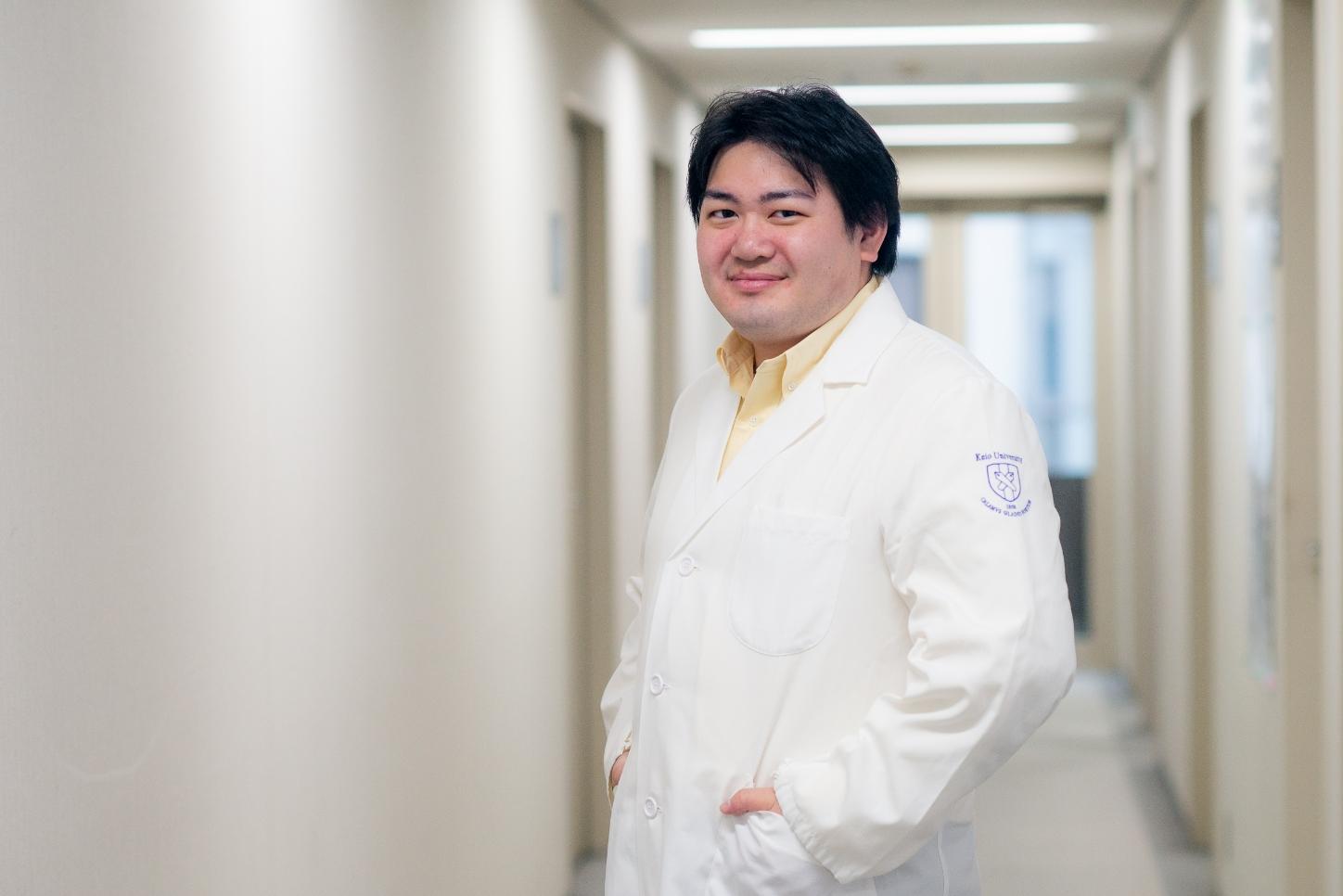
Takayuki Mihara
1st year, Doctoral Programs, Major in Pharmacy, Graduate School of Pharmaceutical SciencesTakayuki Mihara
1st year, Doctoral Programs, Major in Pharmacy, Graduate School of Pharmaceutical Sciences
The piano, which I have been playing continuously since I was a child, is my life's work.
I believe it will continue to be a part of my life,
but I did not choose to become a professional pianist.
As I continued to think about a path other than the piano,
I realized I was interested in the workings of the human body and entered the Keio University Faculty of Pharmacy.
My interest eventually led to the seeds of research,
and I am currently pursuing research from two perspectives.
In the future, I hope to absorb clinical knowledge in a medical setting and contribute it back to the world of academia.
(As of December 2023)
The Piano, a Familiar Presence Since Childhood, Has Become My Life's Work.Connections Forged Through Music Have Led to Recitals and a CD Release.
The piano has been a part of my life for as long as I can remember. My mother graduated from a music university, and she started teaching me directly when I was two years old, though perhaps it was somewhat forced at first. Nevertheless, my affection for the piano grew naturally, and as a child, I sometimes even slept under the grand piano, surrounded by its legs. It has become an indispensable part of my life, and I continue to play it to this day.
After entering university, I received invitations from student clubs, but having played alone since I was little, I feel more comfortable playing solo. In 2019, I received an offer from the Shiba-Kyoyaku Festival executive committee and held a solo concert on an upright piano in a building on the Shiba-Kyoritsu Campus. This connection extended to the 13th Shiba-Kyoyaku Festival in 2020, which was held online due to the COVID-19 pandemic, where I live-streamed my piano recital from a hall built by my high school teacher. I am truly grateful to those who gave me such a valuable opportunity.
Another memorable activity as a pianist was a recording session in 2022. Someone who was close to my piano teacher and had always been very supportive of me established a new record label and invited me to participate. They prepared the best possible environment for me, including the piano tuner who had worked closely with my teacher—a first-class pianist—throughout his life, the piano that the tuner had meticulously cared for, and the engineer who had crafted sound with my teacher. Moreover, the performance was session-recorded at the Watanabe Memorial Hall in my home prefecture of Yamaguchi, and I had a truly wonderful time.
However, I never considered making a living from the piano. My performance style takes time, as I carefully internalize and perfect the masterpieces left by composers. In particular, Beethoven's piano sonatas, which I cherish playing, are pieces I have spent many years mastering. A career in music sometimes requires speed—the ability to immediately tackle and master any piece of music. There was a gap between this and my approach to music. While the piano is my life's work, I decided during my junior and senior high school years to find another way to make a living.
To the Faculty of Pharmacy to Learn the Knowledge and Skills Needed in Clinical Settings.Experiencing the Unique Richness of the Keio University Faculty of Pharmacy, Including the Inter-Professional Education Program.
In high school, I had a vague desire to go to a university or faculty in the medical field. I had a fundamental desire to learn more about the workings of the human body, simply because I was born as a human being, and I wanted to help people through the healing act of medicine.
When choosing from among the medical-related faculties, I thought of pharmacy, which is closely linked to chemistry, a subject I was relatively good at. As I delved deeper into my interests, I realized I had a strong curiosity about "what is actually needed in clinical settings," so I chose the Department of Pharmacy, where I could cultivate more clinical knowledge and skills.
To be honest, I didn't exclusively apply to the Keio University Faculty of Pharmacy for my university entrance exams. However, soon after enrolling, I realized that there is likely no other university with such a comprehensive education in the medical fields. At Keio University, the Inter-Professional Education Program is consistently implemented across the three medical faculties—the School of Medicine, the Faculty of Nursing and Medical Care, and the Faculty of Pharmacy—allowing students to learn about team-based healthcare, which has become increasingly important in recent years, from an early stage. I believe it is an unparalleled environment for building the essential foundation needed to work in a medical setting in the future.
To the Doctoral Programs to Nurture the Seeds of Research Found as an Undergraduate.Two Research Projects Were Presented at Academic Conferences, Reaching a Wider Audience.
After spending six years in the Department of Pharmacy at the Faculty of Pharmacy, I advanced to the Doctoral Programs. I belong to the Pharmacodynamics (Division of) laboratory. The reason I decided to pursue doctoral studies was that I felt it would be a waste not to nurture and develop the seeds of research I had discovered as an undergraduate. The Department of Pharmacy dedicates a significant amount of time to practical training, so I felt that six years as an undergraduate was simply not enough to continue my research.
I am currently working on two main research themes.
One is a study that sheds light on a new aspect of a certain antibiotic. This antibiotic is not only effective against the bacteria that cause specific infectious diseases, but it may also alleviate symptoms through a separate mechanism. To test this hypothesis (the dual effect), I am conducting experiments with mice daily. Through my research, I hope this antibiotic will be used more effectively for patients in the future.
The other is a study using a method called "meta-analysis," which involves compiling numerous existing clinical studies to create a single dataset to answer a clinical question. The research data obtained through this method is highly reliable because it is calculated by integrating data from many clinical studies, and it is used in the creation of "clinical practice guidelines." Clinical practice guidelines are documents that summarize information and evidence on tests and treatments to guide healthcare professionals in diagnosis and treatment. Extracting appropriate evidence from the vast number of clinical research papers in the world is a challenging task, but I am working on it together with the talented colleagues in my division. I have had the opportunity to present both of these studies at academic conferences. I also intend to firmly acquire presentation skills during my time in the Doctoral Programs.
Furthermore, being involved in medical research, I have found that it has something in common with being a pianist. Although the means are different, both bring healing to people's lives. In a broad sense, I see them as the same thing.
After Graduating from the Doctoral Programs, Providing Better Medical Care to Patients Through Research in Clinical Settings.Putting into Practice the Motto of the Pharmacodynamics (Division of): "Our Research Brings Change to the Medical Field."
After completing the Doctoral Programs, I want to go out into the medical field, absorb "living" knowledge, identify the actual problems occurring on the ground, solve them in academia, and give back to the patients. This is the future I envision, inspired by watching the faculty members in the Pharmacodynamics (Division of) where I belong. The faculty members of the Pharmacodynamics (Division of) were originally hospital pharmacists, and all their research themes are rooted in actual clinical practice. They solve problems through research and contribute back to the medical field for the benefit of patients. The greatest appeal of the Pharmacodynamics (Division of) is seeing our research reflected in clinical practice in real time. For example, when our papers are cited in clinical practice guidelines, leading to changes in treatment policies, or when the criteria for selecting antibiotics change, we can truly feel that our research outcomes are advancing medicine and enabling us to provide better medical care to patients.
At Keio University, not only the Faculty of Pharmacy but also other faculties are well-established, and there are many people with advanced knowledge and skills in various fields. The research I am currently engaged in is also made possible by the cooperation and influence of such people. At Keio, you can experience a student life where you are constantly inspired by those around you.
I know very well that studying for entrance exams is tough. But beyond that, an experience awaits that is worth the hardship, or even more. I truly hope that all of you will also get to experience the "rich learning" that is incomparable to anything before.