
To save as many people as possible with new drugs. That desire will never change.
Participant Profile
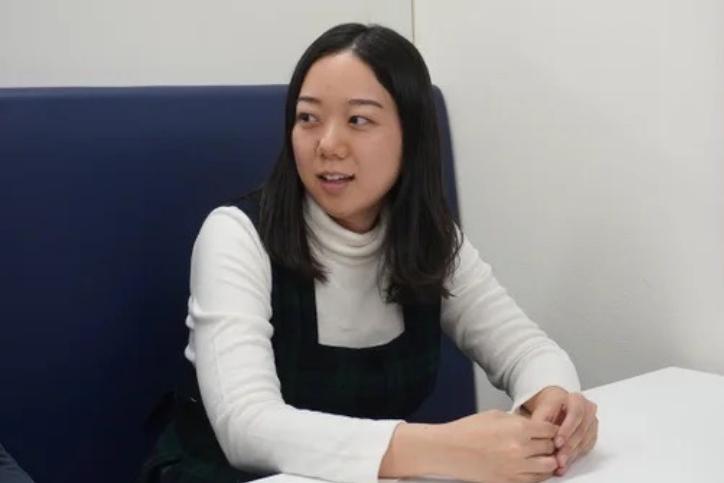
Sayaka Nagami
Graduated from the Department of Pharmacy, Faculty of Pharmacy in 2013. Currently at Ubie, Inc.Sayaka Nagami
Graduated from the Department of Pharmacy, Faculty of Pharmacy in 2013. Currently at Ubie, Inc.
At my previous job at a pharmaceutical company, I was involved in the clinical development of groundbreaking new drugs.
After changing jobs, I am now engaged in business development as a "guide to appropriate medical care."
Although my work has changed, my desire to "increase the number of people saved by new drugs," which I developed during my hospital training at university, remains the same.
I am currently in the midst of balancing childcare and work,
but even after my childcare leave, I want to be involved in a business that brings about major innovations in health promotion.
(As of February 2023)
At Ubie, Inc.
Even when good drugs are created, they often don't reach the patients who need them.I changed careers to become a "guide to appropriate medical care" to solve this problem.
I am currently in charge of business development at the health-tech startup Ubie, Inc. Ubie primarily offers "Ubie," a service that guides users from symptoms to appropriate medical care, and "Ubie Medical Navi," a service package for medical institutions that helps improve the quality of care.
"Ubie" is a service for the general public and patients. By simply answering questions supervised by doctors, users can look up potential diseases, treatments, and available medical institutions based on their symptoms, all for free. "Ubie Medical Navi" includes services like "Ubie AI Symptom Checker," where an AI automatically generates optimal questions for each patient and concisely conveys the results to the doctor, and "Ubie Link," which supports awareness-building. I am currently working with pharmaceutical companies to advance various business developments using these services.
Having previously worked in clinical development at a pharmaceutical company, I have faced the challenges of the pharmaceutical industry firsthand. The most serious of these is that "even when good drugs are created, they often don't reach the patients who need them." I moved to Ubie to solve this difficult problem. Ubie's mission is "To guide people to appropriate medical care with technology." I believe that by facilitating the matching of patients with doctors, or with treatment methods, through our two services, we can help more people live healthy and happy lives.
The challenges of modern medicine I learned about during my training at the National Cancer Center.My university-era desire to "increase the number of people saved by new drugs" remains unchanged.
What shaped my motivation to contribute to society through the pharmaceutical industry was my six years of study in the Department of Pharmacy, Faculty of Pharmacy. I was particularly influenced by my experience at the National Cancer Center during the domestic advanced practical training course. I witnessed medical challenges that cannot be learned from a desk and saw firsthand the reality that there are lives that cannot be saved even with cutting-edge medical care.
In such a situation, I wondered if I could save lives if I were on the front lines of medicine. After much thought, the answer I finally arrived at was, "I want to challenge the limits of current medicine to save as many lives as possible."
At the National Cancer Center, contrary to the cases that could not be saved, there were also instances where patients were saved by new drugs with dramatic effects. I learned how great the joy that groundbreaking new drugs can bring to people is, and with the hope of increasing the number of people who could be saved, I joined a pharmaceutical company after graduation. Fortunately, at that company, I was able to participate in the development of a new drug for hemophilia and experienced the groundbreaking drug receiving high praise from the doctors and patients involved in its development. I realized once again that new drugs can bring about drastic changes.
The desire I had in my university days to "increase the number of people saved by new drugs" remains unchanged even after changing jobs. It is now my duty to ensure that these excellent drugs are delivered appropriately to patients.
I've realized that the pharmaceutical industry makes it easy to balance childcare and work.In the future, I want to be involved in a business that brings major innovations to health promotion.
I am actually on childcare leave right now and have been away from the workplace for about a year, but I have come to realize that industries related to medicine make it relatively easy to balance childcare and work. In the pharmaceutical and health-tech industries where I have worked, remote work is well-established, allowing for various tasks to be done from home, such as participating in remote meetings.
I have many friends who work as pharmacists, and they say, for example, that it's easy to get approval for shorter working hours. The Faculty of Pharmacy has many female students, and it's encouraging to hear so many of them say they are able to balance childcare and work in their jobs.
My future prospect is to continue working after my childcare leave. My work at Ubie is still a work in progress, so of course, I want to continue. I haven't fully mapped out my career beyond that, but in any case, I want to be someone who can be involved in a business that brings about major innovations in people's health promotion.
The broad learning and many experiences at university expand future possibilities.I want to tackle work that contributes to people's health while enjoying it myself.
I was able to have a variety of experiences while at university. I feel that not only my hospital training and research activities, which are useful in my current job, but also my social life was fulfilling. I am still good friends with the people I studied with in the lab, and we still talk about what we're up to. Making lifelong friends is one of the great joys of university life.
I believe that students of the Keio University Faculty of Pharmacy find diverse career paths precisely because they experience a broad range of learning. One of my friends went into the advertising industry to work on disease awareness, and as this shows, there are many ways to contribute to people's health promotion from fields not directly related to pharmacy.
Japan is now called a super-aged society, with a longer life expectancy and a longer period of healthy life, but the great contributions of medical sciences and pharmacology have been instrumental in achieving this. There is great satisfaction in aspiring to study such disciplines, acquiring expertise, and engaging in work that contributes to the health of many people. I myself continue to work with a real sense of "being useful to others." I hope that future students will also enjoy contributing to people's health.