
Experienced Hire: Working in Academic Affairs
Participant Profile
Manual Correction Required
Manual Correction Required
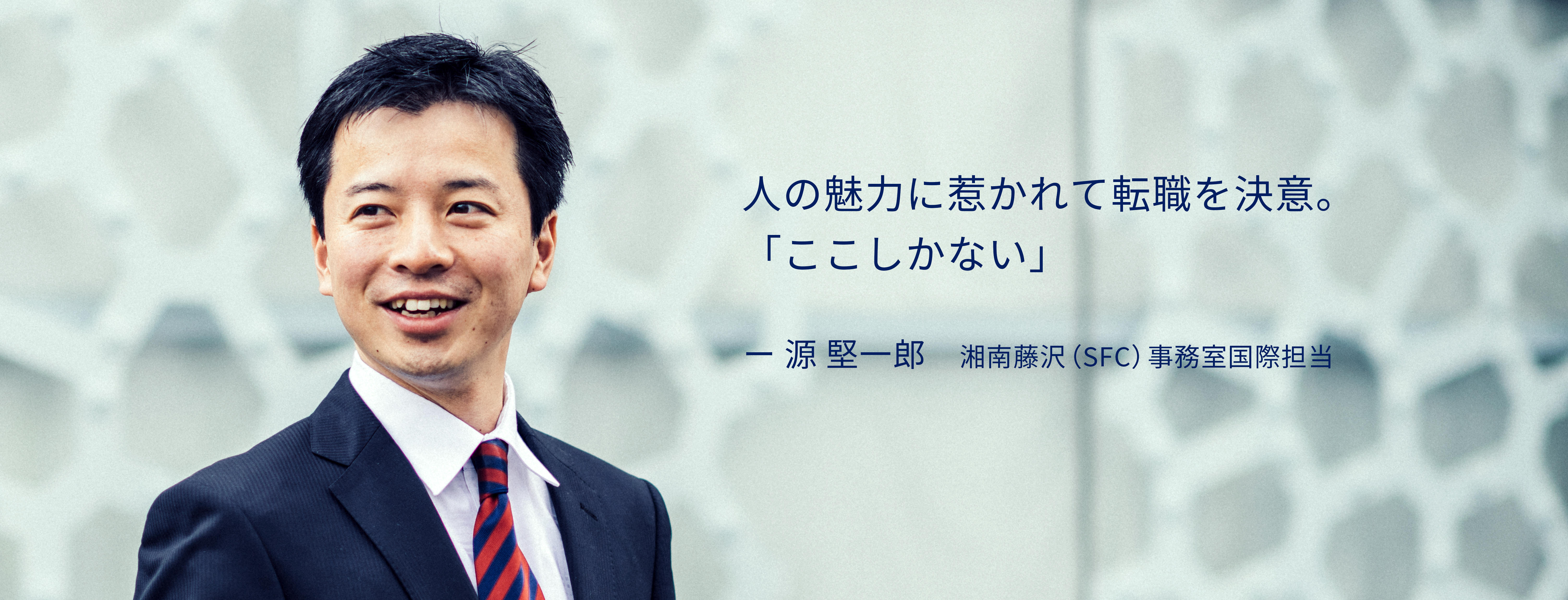
Kenichiro Minamoto landed a job at his dream airline, but at age 30, he decided to change careers. He chose his alma mater, Keio University. What were his reasons? We spoke with Mr. Minamoto, who works in international public relations and supports international students at the globally diverse SFC, about the meaning and appeal of working at Keio University.
"This is the only place for me." The warmth of the people was the deciding factor in his career change.
After graduating from Keio University's Faculty of Economics and completing graduate school, I joined an airline in 2004. I had always loved airplanes and wanted a job in international business. I was thrilled to join the airline I had admired since I was a child. I started my career in frontline customer service at the airport and reservation center, then moved to sales at the head office, and finally was in charge of aircraft asset accounting. When I reached the milestone of 30, I reconsidered my future and decided, "This is the only place for me," and chose to switch careers to my alma mater, Keio University. I had actually considered working at Keio University as a new graduate, but due to the recruitment exam schedule, I had already received an offer from the airline, so I didn't apply.
My strong desire to work at Keio University stemmed entirely from my experiences as a student. At the time, I was a member of the first Student Sports Promotion Committee, organizing sports events within Keio, and I was treated with great warmth by many faculty and staff members. In addition to sports, I actively participated in various university-sponsored events, such as training camps tracing the historical sites of Yukichi Fukuzawa and ski trips. The impression the staff made on me was very positive, and I thought that working alongside them and supporting students who are about to enter the workforce would lead to a very fulfilling professional life. Perhaps I was drawn to the supportive bond among Keio students, faculty, and staff—the spirit of *Keio Gijuku Shachu* (community cooperation). Even now, in my work, I often receive cooperation from Keio University alumni who are active in society and from the Mita-kai (the Keio University alumni association), and I frequently feel grateful for the breadth and strength of this network.
The great satisfaction of a job that conveys "feeling."
After joining Keio University, I first worked in academic affairs at the Office of Student Services on the Hiyoshi Campus. It's a workplace that mainly supports first- and second-year students in the Faculty of Science and Technology. With education, research, and medicine as the pillars of our operations, the academic affairs staff are at the core of "educational" support. (Organizational names vary by campus.) We support a very wide range of areas: academic affairs staff who manage course registration, grades, and curriculum development; student life staff who support extracurricular activities and scholarships; career services staff who provide career counseling, introduce alumni, and hold job guidance sessions; and international affairs staff who handle international student support, exchange programs, and other internationalization initiatives. After my role with the Faculty of Science and Technology, I transferred to SFC, where I am now in charge of international affairs in the Office of Student Services. Since SFC has a relatively large number of international students, I am engaged in various tasks aimed at the internationalization of the entire campus. International public relations is one of them. As Keio University is not that well-known overseas, international PR involves a lot of steady work, such as repeatedly contacting high school teachers and prospective students abroad and providing detailed information about the university and its English-language programs. Currently, we are also active in PR through social media centered on the internet, so I also update our webpages and Facebook. The international affairs staff's job also includes supporting international students' daily lives after they arrive. Many international students come to Japan right after graduating from high school, so they face many difficulties setting up their lives here. We provide daily life support, such as accompanying them to the city office and bank, or helping them sign up for a mobile phone contract. I believe it is through such support that we gradually close the distance with students and build a relationship of trust.
In this context, one of my major missions—and a part of my job I find very interesting and rewarding—is figuring out how to best explain the appeal of Keio University in various public relations situations. Although I am in charge of international affairs dealing with overseas partners and international students, I actually had no prior experience abroad. To be honest, the language barrier is a major hurdle, but I believe that what students, including international students, are looking for is not just "language." I think it's important to convey "feeling" from the same perspective. I've always enjoyed talking and communicating with people, so now I'm doing my best to leverage that as my strength. Of course, I make a daily effort to do the necessary studying to convey that "feeling." I'm very grateful that the university partially subsidizes tuition for things like English conversation school.
Above all, the appeal is the "people."
As a workplace, I believe the best thing about Keio University is, first and foremost, the "people." The barriers between departments are low, and everyone is very supportive, which makes it a very easy place to work. For events like the entrance and graduation ceremonies and entrance examinations, we have a system of "staff secondment" where staff from various departments come together to cooperate. This gives us the chance to get to know people from other departments with whom we don't usually interact in our daily work. Additionally, job rotations are conducted without barriers between departments, providing opportunities to experience various types of work, which I believe contributes to personal growth. There are also various training programs available from the first year, making it an excellent environment for career advancement. I myself recently participated in a short-term overseas training program. I went to an international leadership seminar hosted by the University of Sydney, where I learned what the university is doing for prospective international students and staff amidst the growing international focus in university management. Although it was a short period of one week, I gained many insights and was able to interact with staff from the University of Sydney and other universities, which was a great learning experience.
When it comes to experienced hires, some companies may expect specialized expertise, but at Keio University, even experienced individuals are included in the job rotation system just like new graduates. To do a better job within that system, I believe it's important to have a sincere and flexible perspective on how you can apply yourself in each situation, considering your previous work experience while also aligning with Keio's culture and traditions. Keio University sends the message of "independence and self-respect" to its students, and the same applies to its staff.