
Tamaki Miyauchi - Retiring in AY2019
Participant Profile
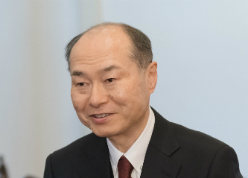
Tamaki Miyauchi
Statistics, Quantitative Analysis of the Labor Market1984: Graduated from the Faculty of Economics, Keio University 1987: Completed the Master's Program at the Graduate School of Economics, Keio University 1990: Withdrew from the Doctoral Programs at the Graduate School of Economics, Keio University after completing course requirements After serving as an assistant in the Faculty of Economics at Keio University, assumed current position in 1993 *Profile and position are as of the time of the interview.
Tamaki Miyauchi
Statistics, Quantitative Analysis of the Labor Market1984: Graduated from the Faculty of Economics, Keio University 1987: Completed the Master's Program at the Graduate School of Economics, Keio University 1990: Withdrew from the Doctoral Programs at the Graduate School of Economics, Keio University after completing course requirements After serving as an assistant in the Faculty of Economics at Keio University, assumed current position in 1993 *Profile and position are as of the time of the interview.
In an Atmosphere of Freedom and "Saiyansu"
Since being hired as a university assistant in the Faculty of Economics in 1988, I have been able to continue my research and educational activities for 32 years in the rich academic environment of Mita. This has been a wonderful experience for me, one that could even be called a miracle. Above all, this place is filled with an atmosphere of freedom in research and education, and of "saiyansu," which means *jitsugaku (science)*—an empirical discipline that stands in contrast to "kyogaku" (empty learning). This atmosphere has been passed down uninterruptedly since the founding of the Juku, and within it lies an accumulation of brilliant and rich research achievements pioneered by our predecessors. There was never any atmosphere that sought to particularly encourage or hinder specific research or teaching. Initially, I was not very conscious of the importance of this atmosphere. However, at some point, I began to feel a strong sense of pride in the importance of this atmosphere and the rich accumulation of research that has resulted from it, and I came to hope to infuse this flavor into my daily research and educational activities.
When I once picked up and read "An Outline of a Theory of Civilization", I learned the origin of the spirit of this academy, which values such an atmosphere. I also realized that it clarifies a guiding principle toward civilization not just for this academy, but for all of us who belong to this society. In other words, I realized that the content written in "An Outline of a Theory of Civilization" transcends its significance as something we should understand simply because we belong to this academy; it is something that society as a whole should share and use as a guide for thought and action. In the second chapter of this book, there is a passage that describes the state of a civilized society in comparison to a barbaric one, stating, "While it brings the things of heaven and earth within the grasp of rules, within them it allows for vigorous independent activity." This describes the people of a civilized society who discover "regularities" in all observed phenomena concerning the behavior of nature and society, as well as human thought and action, and who think and act to guide these subjects in a better direction using those regularities. They, in a civilized society, are people who share a respect for scholarship based on such "saiyansu." The book further concludes, "It is as if human wisdom, having been applied to the present day, has some left over with which to plan for the future." This means that even if a study based on "saiyansu" is not useful for today's problems and it is uncertain when it will be useful, we should prepare for it from today for problems that may arise in the future. I understand that this spirit is connected to the atmosphere of "freedom" in research and educational activities.
Without this atmosphere of freedom and "saiyansu," my own research probably could not have been established. There is a study I began around 1987 as my life's work. The content of that research was the construction of a stochastic model of labor supply for married-couple households, where the employment choices of the spouses affect each other's utility levels. This model had a significant problem that had to be overcome. The problem was that multiple Nash equilibria could exist, and in such cases, a one-to-one correspondence could not be established between the multiple solutions of the model regarding each spouse's employment/non-employment status and the observed facts. Since each spouse's utility function is ordinal, it was also difficult to apply cooperative game theory, which would maximize total gains. For this reason, I was sometimes exposed to harsh criticism, but on the other hand, I was truly fortunate to be blessed with a supervising professor, senior colleagues, and fellow researchers who expressed great interest, describing the research as something they had "never seen before," and consistently gave me advice and encouragement. Unfortunately, I have not yet found an effective path to solving this problem, but I intend to continue this research in the future. I strongly feel that the reason I can still think this way, even as I face retirement, is because a community of researchers has been formed at this academy that shares an atmosphere of freedom and "saiyansu," which shows interest even in such heretical research.
Once, a Professor Emeritus with whom I was walking in front of the old library at Mita remarked, "Being at Mita cleanses the soul, like being in a temple. You become detached from the secular world and your mind becomes clear." I feel the same way these days. I can sense the spirit of the predecessors who built the tradition of this academy, which is supported by a rich accumulation of research. I sincerely hope that this academy will continue to further develop its accumulation of research in the future.
(Interview conducted in December 2019)