
Kazuko Furuta - Retiring in AY2017
Participant Profile
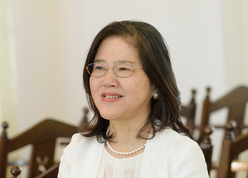
Kazuko Furuta
Asian Economic History1977: Graduated from the College of Arts and Sciences, The University of Tokyo 1979: Completed the Master's Program in the Graduate School of Human Relations, The University of Tokyo; Master of International Studies 1982: Completed the Master's Program in the Department of History, Princeton University; M.A. 1984: Withdrew from the Doctoral Programs in the Graduate School of Human Relations, The University of Tokyo, after completing course requirements 1988: Completed the Doctoral Programs at Princeton University; Ph.D. After serving as an assistant at The University of Tokyo and as an associate professor and professor at Toyo Eiwa University, assumed her current position in 1997. *Profile and position are as of the time of the interview.
Kazuko Furuta
Asian Economic History1977: Graduated from the College of Arts and Sciences, The University of Tokyo 1979: Completed the Master's Program in the Graduate School of Human Relations, The University of Tokyo; Master of International Studies 1982: Completed the Master's Program in the Department of History, Princeton University; M.A. 1984: Withdrew from the Doctoral Programs in the Graduate School of Human Relations, The University of Tokyo, after completing course requirements 1988: Completed the Doctoral Programs at Princeton University; Ph.D. After serving as an assistant at The University of Tokyo and as an associate professor and professor at Toyo Eiwa University, assumed her current position in 1997. *Profile and position are as of the time of the interview.
Why Asian Economic History? The Joy of Pioneering a New Field
In 1997, the Keio University Faculty of Economics established a course called "Asian Economic History," and I was appointed to teach it. At that time, very few universities in Japan had an "Asian Economic History" course within their economics faculties. Analyzing the history of the societies and economies of the people of Asia, who make up more than half of the world's population, is significant as it provides an opportunity to reconsider our understanding of global socioeconomic history. Asian economic history is also an academic field that offers an indispensable perspective when considering the future of the world, including issues such as population, the environment, and the nature of market economies. I believe that the decision to recognize the need for this field and establish the "Asian Economic History" course early on was a testament to the insight of economics at Keio. As the person in charge, I was able to lead a rewarding life as a researcher and educator.
My journey as a researcher began with a study that examined the mutual relationship between the development of silk-reeling technology in Japan's Joshu and Shinshu regions during the early Meiji period and its counterpart in China's Huzhou and Shanghai, comparing the two. Here, instead of focusing on Japan and China as national units, I concentrated on the connections between regions within the broader context of East Asia. The realization of the importance of distribution structures in technology transfer that I gained here led to my next stage of research on the "Shanghai Network." In that research, my focus shifted from the geographical locations of production and consumption to the spaces through which goods, mediated by people, moved. This, in turn, led to an interest in markets where exchange, distribution, and intermediation take place. My appointment at Keio came just as I was advancing this line of research.
During my tenure at Keio, I took on the challenge of merging these interests into research on market order in China. Since the 10th century, China has been a society with strong market characteristics, where vast areas of the economy—such as land sales, choice of occupation, landlord-tenant relationships, and employment relations—were governed by private contracts. On the other hand, it was also a society where the maintenance of order through state or community regulations was relatively weak, and a heavy emphasis was placed on private order-keeping, with chains of intermediaries and personal guarantees holding great significance. Driven by the question of why such a highly competitive and unstable market, lacking public institutions, did not collapse but was socially sustained, I have accumulated research focusing on the quality of markets, goods, and information in Chinese history. It was also a pleasure to publish the collaborative research, *Imitation, Counterfeiting and the Quality of Goods in Modern Asian History* (Springer), edited by Furuta & Grove, which summarized the proliferation of counterfeit markets in Japan and Asia as an outcome of the Keio/Kyoto University joint project on "Improving the Quality of Markets." Thus, although the subjects of my research have changed over time, I believe my methodological approach has remained quite consistent.
At Keio, I was also able to take on the task of training researchers in Asian economic history at the graduate level. While my seminar was not one that attracted a large number of graduate students, it is a great joy that several of them earned their doctorates and have grown into researchers who are now active on the front lines of Asian economic history. In my undergraduate seminars, I also had the pleasure of encountering the "Keio Boys," whose atmosphere was completely different from what I had experienced at the University of Tokyo, Princeton University, and Toyo Eiwa University before coming to Keio. I am grateful for all of these experiences.
(Interview conducted in February 2018)