
Isao Hada - Retiring in AY2018
Participant Profile
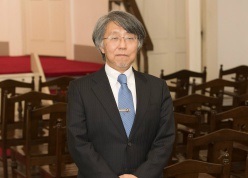
Isao Hada
The Jewish Question, Ethnic Issues, Modern German Literature and Thought1977 Graduated from the Faculty of Letters, Keio University 1979 Completed the Master's Program at the Graduate School of Letters, Keio University 1981 Appointed as an Assistant at the Faculty of Economics, Keio University 1982 Withdrew from the Doctoral Programs at the Graduate School of Letters, Keio University, after completing course requirements 1988 Appointed as an Associate Professor at the same faculty 1995 Appointed as a Professor at the same faculty (to present) *Profile and position are as of the time of the interview.
Isao Hada
The Jewish Question, Ethnic Issues, Modern German Literature and Thought1977 Graduated from the Faculty of Letters, Keio University 1979 Completed the Master's Program at the Graduate School of Letters, Keio University 1981 Appointed as an Assistant at the Faculty of Economics, Keio University 1982 Withdrew from the Doctoral Programs at the Graduate School of Letters, Keio University, after completing course requirements 1988 Appointed as an Associate Professor at the same faculty 1995 Appointed as a Professor at the same faculty (to present) *Profile and position are as of the time of the interview.
A Commitment to Cultivating a "Liberal Arts" Education...
Since this is about "memories," I will speak as things come to mind. It has been nearly 40 years since I began teaching at the Faculty of Economics. I have taught courses such as German, independent research seminars, ethnic and cultural studies, and representation and culture studies. My research area, "the Jewish question," spans a wide range of fields including religion, history, politics, economics, culture, and media studies, so I have tried my best to reflect this in my classes. At the same time, as I have concurrently served as the Director of the Keio Research Center for the Liberal Arts based at the Hiyoshi Campus, the Director of the Hiyoshi Library, and the principal of the high school (Jukuko), I have also been involved in discussions and program development related to liberal arts education, including at the high school level.
Furthermore, at the Fukuzawa Yukichi Memorial Juku for the Advancement of Civilization, which was established to commemorate Keio's 150th anniversary, I was involved as a steering committee member and program coordinator from its launch through its tenth session. This blessed me with opportunities to interact not only with Keio students but also with many working adults and students from other universities. At the Keio Research Center for the Liberal Arts, through the creation of the entrance ceremony (now the welcome event for new students), I was able to create opportunities to share the various possibilities the university holds, not only with new students but also with the current students who welcome them. With the "Shonai Seminar," established at the Keio Town Campus in Tsuruoka (TTCK) in Yamagata—home to the Institute for Advanced Biosciences—we aimed to think about "life" from multiple and intensive perspectives. There, I have had profound (?) experiences, literally immersing ourselves in the unique region of Shonai, engaging in activities like Shugendo ascetic training with students, and holding deep discussions.
Let me list a few things I have thought about and felt amidst these experiences.
The Hiyoshi Campus, where my office is located, is where first-year students from all faculties, except for SFC, begin their university life. For that reason, even just at Hiyoshi, the students I have interacted with have been incredibly diverse, and as a faculty member, I have been able to learn a great deal from them. However, at the same time, I have often been dismayed by a lack of awareness regarding a "liberal arts" education. If we consider a liberal arts education to be the foundation for "living a better life," then what I keenly felt as the library director, for example, was the students' disengagement from books and the library. Not just at Hiyoshi, but I believe Keio's libraries, with their vast number and variety of collections, are among the best university libraries in Japan. They are treasure troves of "knowledge" filled with inexhaustible riches, and also labyrinths of "knowledge" with unfathomable depth and breadth. Why don't students actively use them to "live a better life"? It is such a waste. On the other hand, from the Jukuko students I worked with for about four years, I sensed extremely high potential. I became convinced that if the university and its faculties could properly receive them, we could expect significant growth. Furthermore, they gave me hope that the atmospheric shifts and chemical reactions created when they mix with students who enter from paths other than the affiliated schools could lead to the creation of something new and unprecedented.
Of course, it would be best if "living a better life" could be consciously pursued in the course of everyday campus life, or if there were a smooth system in place to support it. However, "daily routine" often obstructs this and tends to make us complacent. That is precisely why it is necessary to place oneself in an environment that is slightly different from the "everyday." The different world you experience and the scenery you don't normally see there should provide an unparalleled opportunity to reflect on your past, re-examine your present, and envision your future. I believe the Juku for the Advancement of Civilization and the Shonai Seminar were precisely such places. I also believe that through such experiences, the foundation for "living a better life" is built—in other words, a "liberal arts" education is cultivated.
The four years of university pass in the blink of an eye. For that very reason, I hope that you will make the most of these four years to contribute to the future. To do so, I hope you will develop a commitment to your "liberal arts" education—the foundation of your very self—and continue to polish, broaden, and deepen it throughout your life.
(Interview conducted in December 2018)