
Eiji Hosoda - Retiring in AY2018
Participant Profile
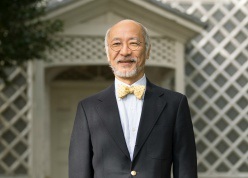
Eiji Hosoda
Environmental Economics1977: Graduated from the Faculty of Economics, Keio University 1980: Assistant, Faculty of Economics, Keio University 1982: Completed the master's program at the Graduate School of Economics, Keio University 1987: Associate Professor, Faculty of Economics, Keio University 1994: Professor, Faculty of Economics, Keio University 2001: Dean of the Faculty of Economics, Keio University (until 2005) *Profile and position are as of the time of the interview.
Eiji Hosoda
Environmental Economics1977: Graduated from the Faculty of Economics, Keio University 1980: Assistant, Faculty of Economics, Keio University 1982: Completed the master's program at the Graduate School of Economics, Keio University 1987: Associate Professor, Faculty of Economics, Keio University 1994: Professor, Faculty of Economics, Keio University 2001: Dean of the Faculty of Economics, Keio University (until 2005) *Profile and position are as of the time of the interview.
Free Research and Education in a Spirit of Independence and Self-Respect
My major is environmental economics, and my main theme within that field is the various issues related to the cyclical use of resources. To put it simply, my area of expertise is the economics of waste disposal and recycling. At the Mita Campus, I have taught "Environmental Economics" and "The Economics of Waste and Pollution" in alternate years. I also taught "Economy and Environment" every year at the Hiyoshi Campus.
Nowadays, no one would be surprised that subjects like "Environmental Economics" or "The Economics of Waste and Pollution" are offered as university courses, but when these subjects were first established, it was quite revolutionary. In the 1980s, when I was hired as an assistant at Juku, such subjects were not in the curriculum of the Faculty of Economics. Therefore, I was not hired as a faculty member in charge of environmental economics.
At that time, environmental economics was just beginning to be recognized in some corners of the world, and in Japan, it was a completely unfamiliar term. I was often asked, "What is environmental economics?" However, when global environmental issues came into the spotlight at the 1992 United Nations Conference on Environment and Development, the so-called Earth Summit, the need for economic analysis of the environment suddenly began to be recognized. And so, major universities around the world began to offer courses in environmental economics.
Juku did not fall behind this trend. It was one of the first universities in Japan to incorporate environmental economics into its curriculum. It also added a course called "Economy and Environment" to its general education subjects to provide fundamental education on the relationship between the economy and the environment.
The pace of curriculum reform during this period was extremely fast, and I was astonished to find myself unexpectedly at the center of it. Normally, changing the curriculum within a faculty is a major undertaking, sparking a hundred different arguments. It was common for heated debates to continue endlessly, and it was considered a good outcome if anything was decided at all; often, nothing was decided. Despite this, the responsiveness and flexibility of the Faculty of Economics in recognizing environmental economics as a new field of economics and establishing related courses were truly remarkable.
To begin with, my research had nothing to do with environmental issues. When I remained at the university, I was researching topics like economic methodology and multi-sectoral economic analysis. It is true that after returning from my studies in the UK in 1985, I began to study environmental issues quite seriously, but I was still a newcomer to environmental economics. For the faculty to entrust a young researcher like me with courses related to the field was a bold decision and a surprise to me as well. I believe this was only possible because of the free-thinking and liberal academic culture of the Faculty of Economics.
Thanks to this, I was able to thoroughly research and teach the fundamental theories, institutional aspects, and policy arguments of environmental economics. I was also fortunate to receive a generous education and research grant from Tokio Marine & Fire Insurance Co., Ltd. (as it was then known), which significantly expanded my research network. Although my progress has been at a snail's pace, I have nonetheless published the results of my research in international professional journals and books.
And in 1995, along with pioneers in this field such as Kazuhiro Ueta of Kyoto University, Shunichi Teranishi of Hitotsubashi University, and Fumikazu Yoshida of Hokkaido University, I co-founded the Society for Environmental Economics and Policy Studies and was able to contribute to building a network for research and education in environmental economics. Today, the management of this society has been passed on to younger researchers, and it is more vibrant than ever.
Although my contributions may be modest, I am sincerely grateful that I was able to contribute to the research and education of environmental economics, thanks to the free academic culture of independence and self-respect at Juku. I intend to continue on my path of new research and education, never forgetting this feeling of gratitude.
(Interview conducted in December 2018)